
Indian manufacturer of uniaxial geogrids | Uniaxial Geogrid supplier and exporter
Uniaxial Geogrids – High Quality Soil Reinforcement for Retaining Wall and Road Constructions.
Singhal Industries Private Limited is a reputed Uniaxial Geogrid manufacture, supplying and exporting company from India which provides reliable geosynthetics for use in retaining walls, highways, bridge abutments, embankments, foundation work, slope stability and road construction projects.
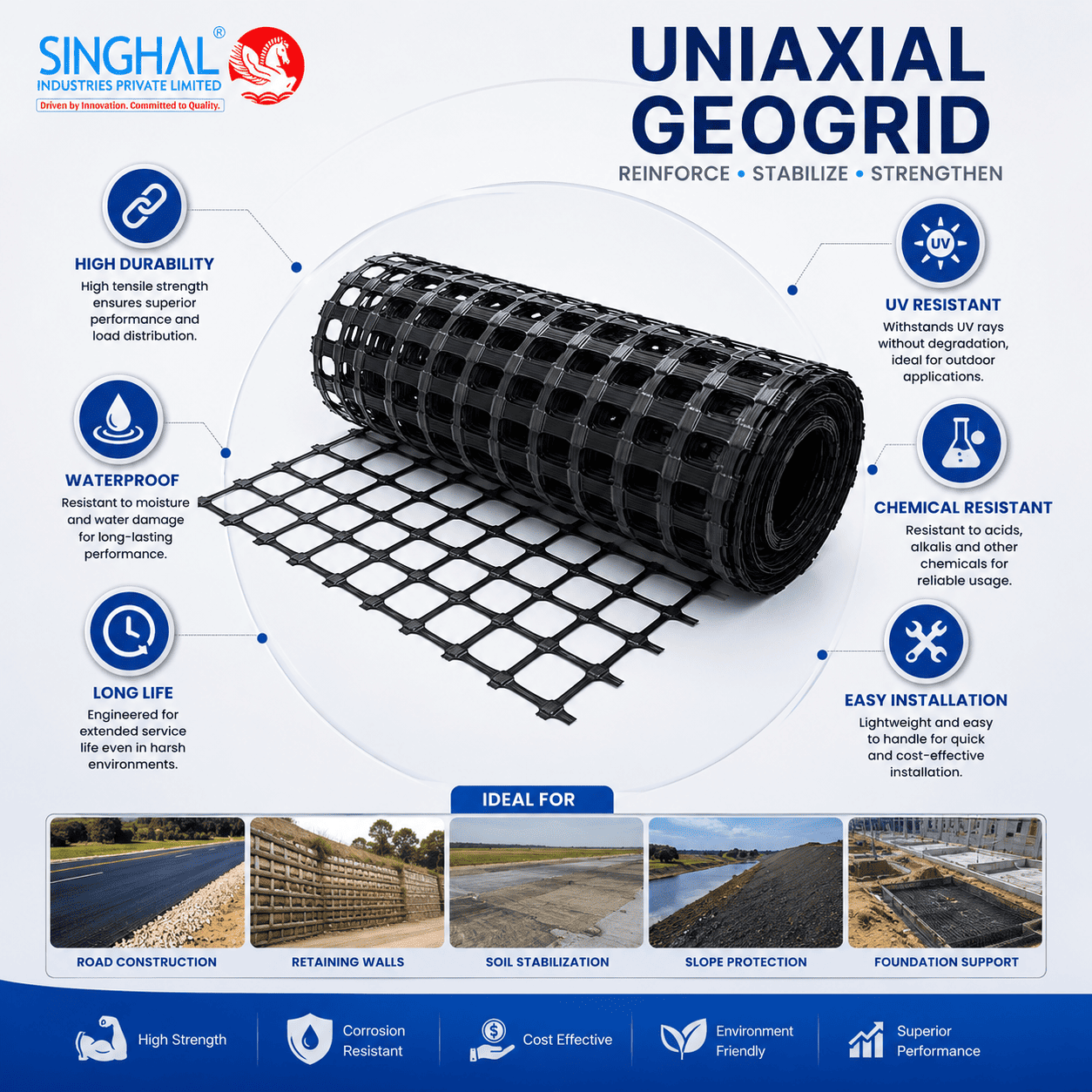
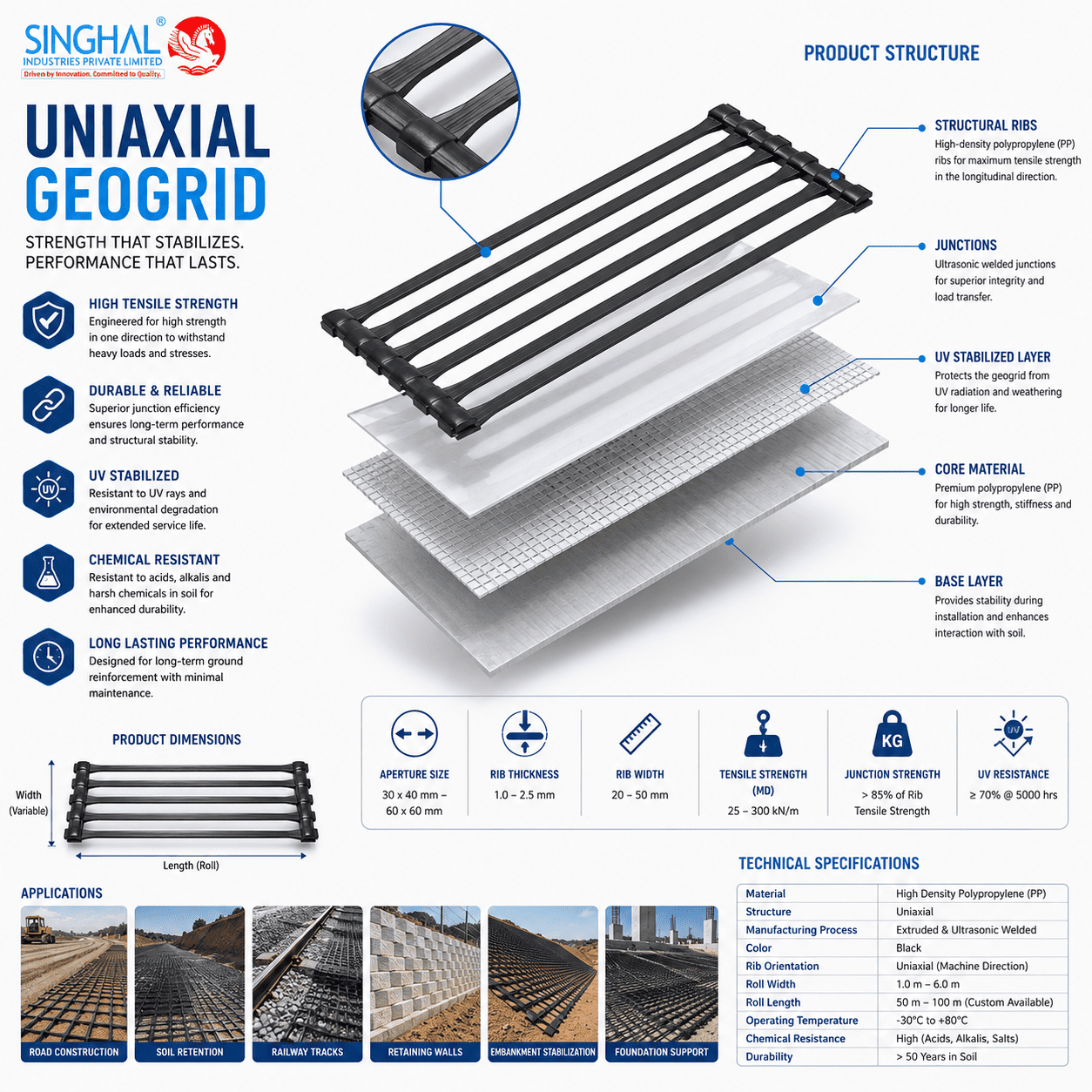
Uniaxial Geogrid has a high tensile strength in a single major direction. This used where there is a requirement to reinforce the soil against long-term stresses, lateral movement, settlement or sliding.
Uniaxial Geogrids are among the most reliable soil reinforcement systems available for use by civil engineers, EPC companies, road contractors, geotechnical experts, and construction groups building oil and gas facilities and landfills.
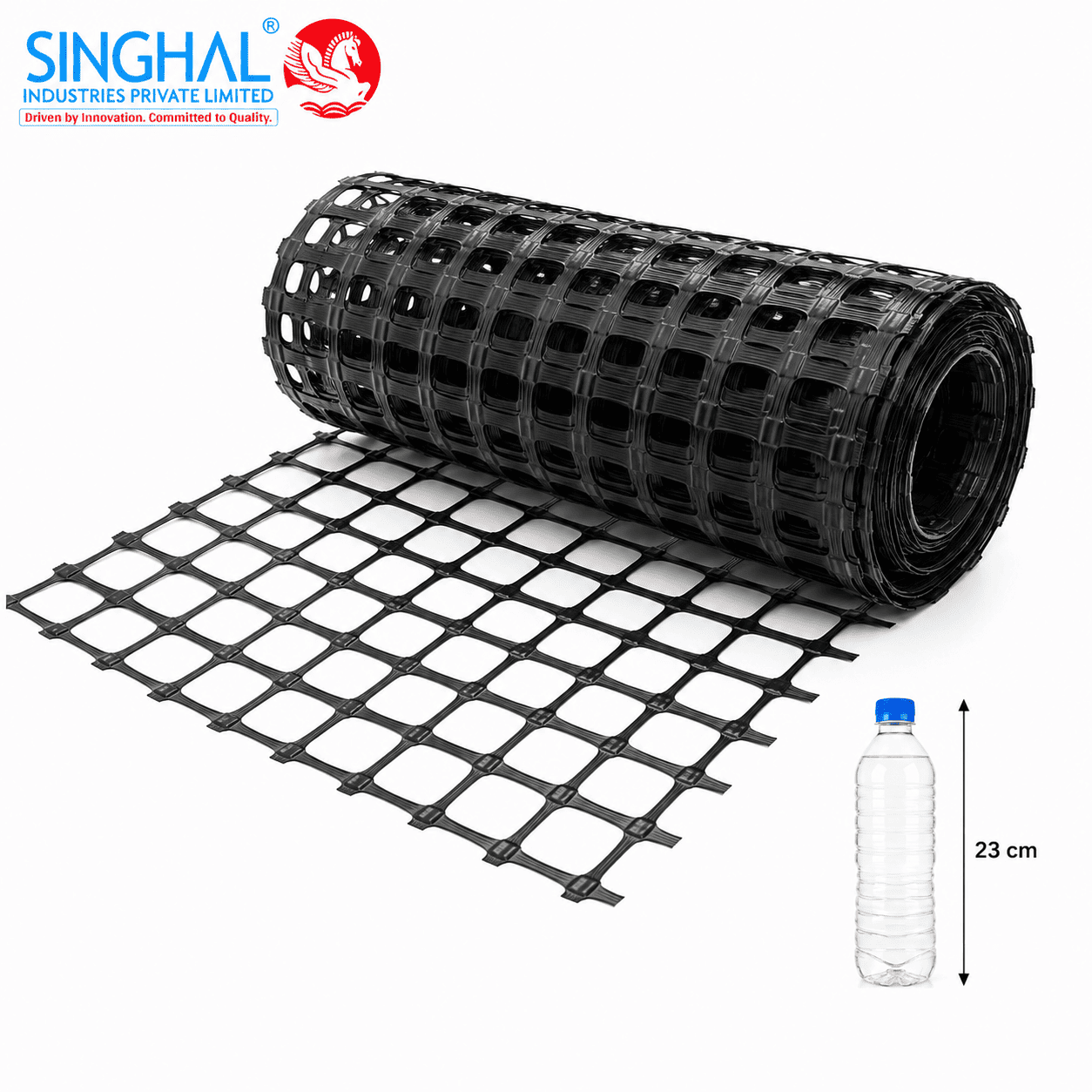
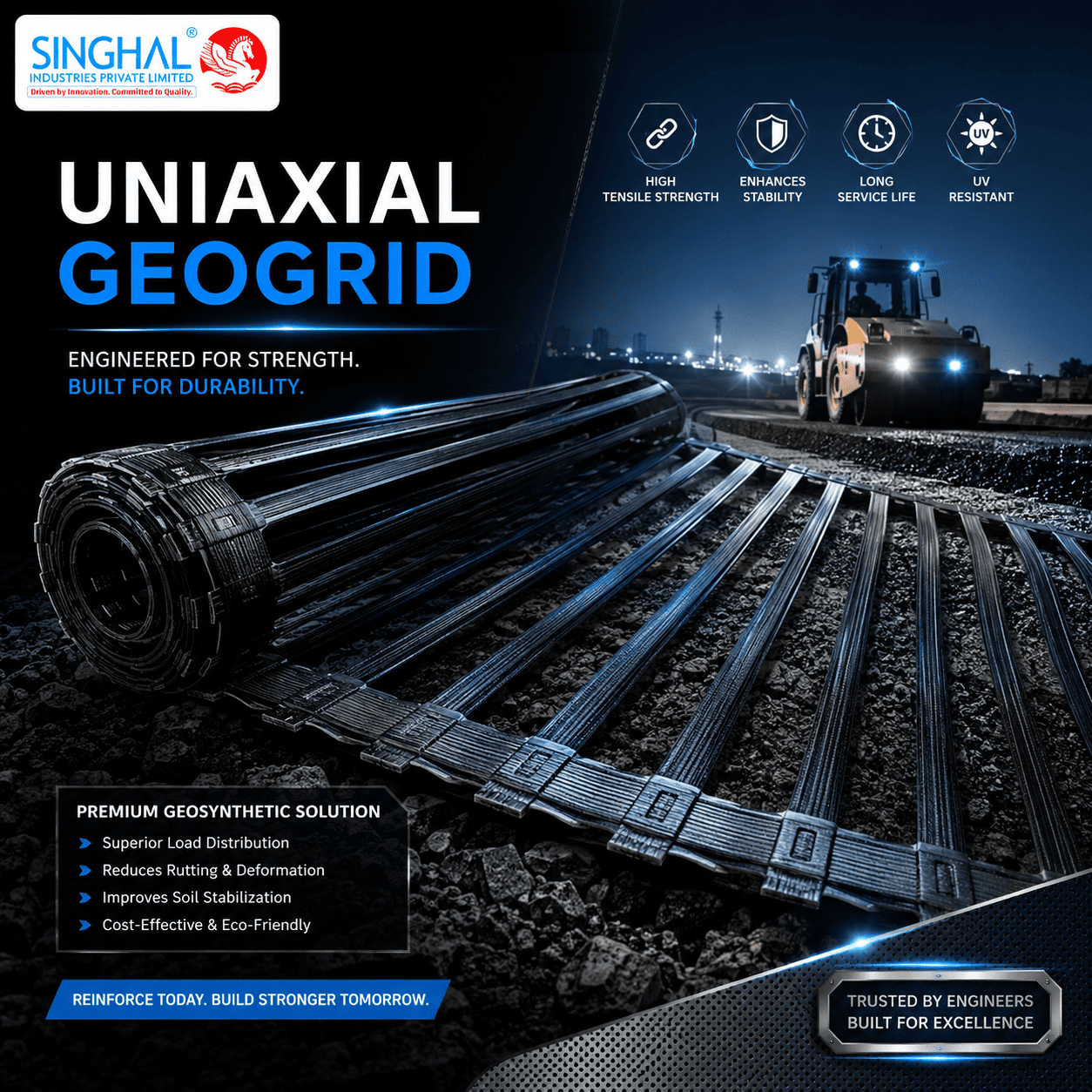
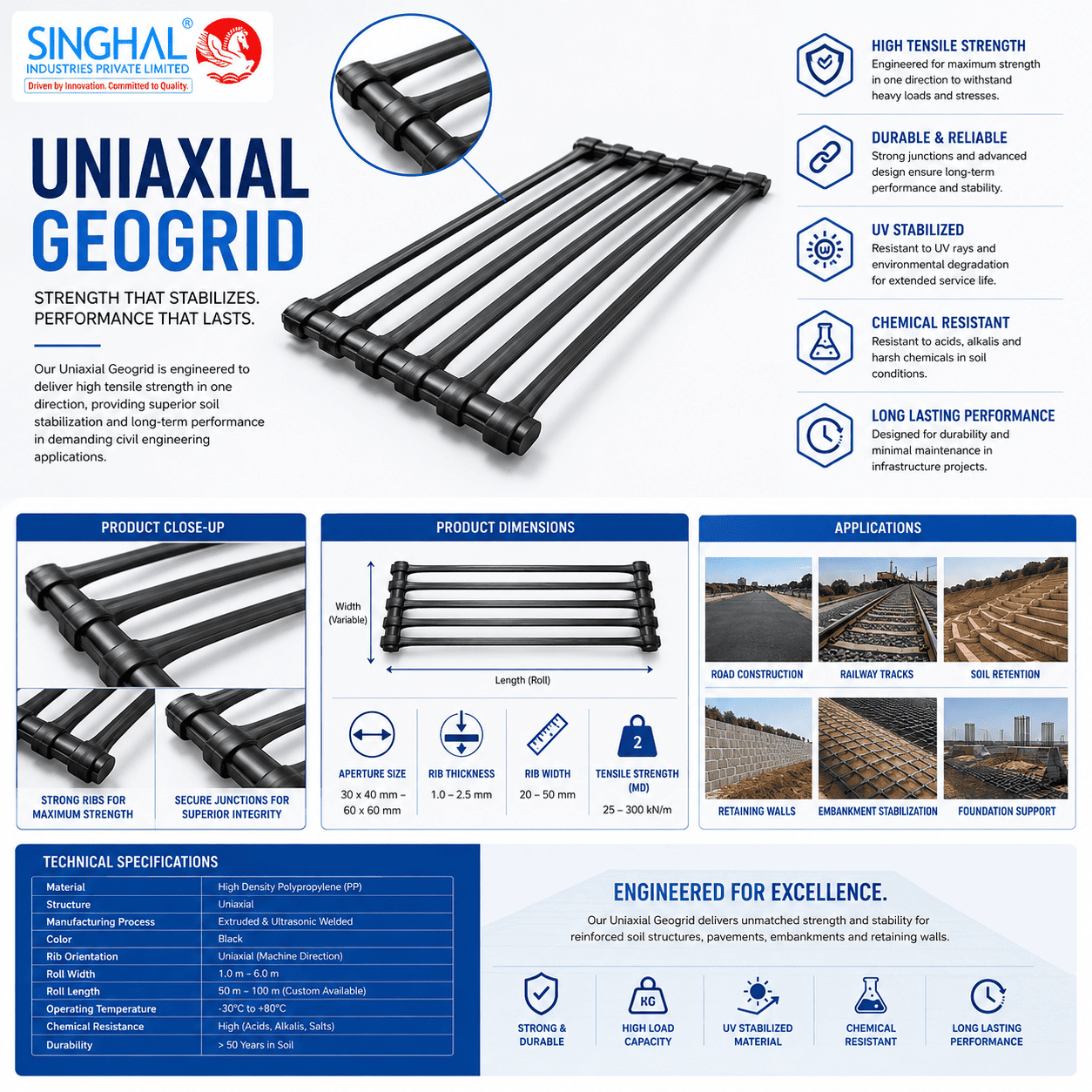
Uniaxial Geogrid is a geosynthetic grid material which is applied to reinforce the soil and enhance the stability of the structure in the civil engineering construction. It possesses a high tensile strength primarily in one direction and is therefore useful when applied in a known direction in which to resist the loads or stresses.
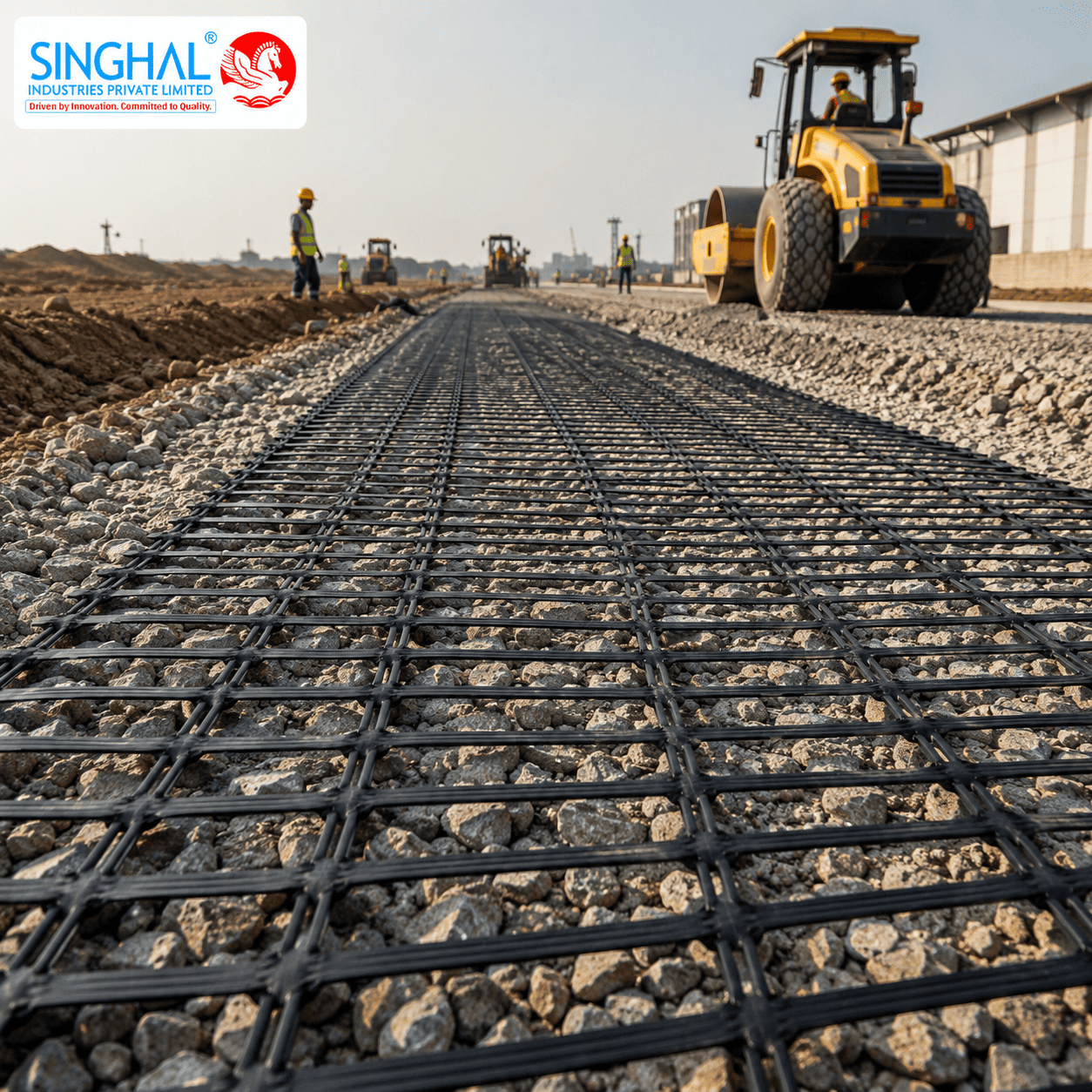
It is frequently used for reinforcement behind retaining walls, under pavements, highways, embankments, and in foundation systems where extra strength and stability is required by the soil.
Uniaxial Geogrid is also different from flat geotextile fabric in that it has an open grid configuration, and is interlocking with soil and/or aggregate. This interlocking action can provide load transfer and enhance the performance of reinforced soil systems.
Standard Uniaxial Geogrid
Useful to reinforce soil in general as well as roads support and foundation repair and retaining wall construction.
HDPE Uniaxial Geogrid
Produced with high-density polyethylene for toughness as well as flexibility, abrasion resistance in addition to geotechnical strength.
Retaining Wall Geogrid
designed to support reinforced soil walls, basement wall retaining walls and bridge abutments, gravity walls or slopes.
Road Construction Geogrid
Utilized below highways, pavements and access roads. It is also used in heavy-load areas to enhance the soil's performance.
Custom Uniaxial Geogrid
Made to order according to the requirements of the buyer for size as well as aperture design, strength grade and for project-specific usage.
Uniaxial Geogrid can be found in a variety of standard and custom configurations:
A custom length, width as well as the tensile strength level and aperture designs can be provided depending on the wall's dimensions and types of soil, the load requirements, slope angle, and design.
The company is Singhal Industries Private Limited, Uniaxial Geogrid is manufactured with an eye on the strength of the material and grid consistency, the tensile properties, as well as project reliability.
Step 1: Raw Material Selection
High-quality HDPE or a the appropriate polymer material is picked according to the reinforcement's performance and the requirements for application.
Step 2: Sheet or Strip Formation
The polymer is then processed into strip or sheet form with uniform thickness and controlled thickness. structure.
Step 3: Grid Formation
The grid pattern is created to create open spaces that allow soil and aggregate to interlock.
Step 4: Orientation Process
The grid is designed to be oriented in one direction, allowing for an impressive tensile strength in the primary path of load.
Step 5: Roll Conversion
When it is finished, Geogrid is made into rolls that allow for easy transportation, handling and even installation on the site.
Step 6: Quality Checking & Packing
Rolls are tested for the strength, consistency of aperture size, surface quality and are packed securely for delivery.
Singhal Industries Private Limited is a dependable manufacturer and supplier of Uniaxial Geogrid and also an exporter of Uniaxial Geogrids that are used for road and embankment geosynthetic reinforcement, retaining walls foundation as well as in various infrastructure works.
Our Strengths include:
We focus on supplying reliable Uniaxial Geogrids to corporations, contractors, EPC firms, civil engineers, road constructors and Industrial buyers.
Uniaxial Geogrid is utilized to reinforce soil embankments, retaining walls, embankments slope stabilization, foundations for road construction, as well as bridge and bridge-abutments.
Uniaxial refers to that the Geogrid has been designed and constructed to offer more tensile force, mostly only in one direction.
Uniaxial Geogrid is usually constructed from HDPE or other geosynthetic polymers.
It is employed behind retaining walls of retaining because it is a strong and directional reinforcement.
Yes, it's utilized under highways, roads as well as roads for access, pavements and in soil areas with weak foundations.
Uniaxial Geogrid provides strength mainly in one direction, whereas Biaxial Geogrid provides strength in two directions.
Uniaxial Geogrid refers to the direction of strength, while Polyester Geogrid refers to the type of material.
Yes, it may be used for erosion prevention through soil stabilization on embankments, slopes, and reinforced surfaces.
It is indeed light that is roll-based and is able to be cut or positioned in accordance with the site's requirements.
Yes the strength of the tensile is one of the major advantages from Uniaxial Geogrid.
Yes, the width length, length, aperture style and strength grade may be altered.
HDPE Uniaxial Geogrid can be used for industrial sites, highways, foundations, retaining walls and in heavy-load soil reinforcement.
Contractors for roads, EPC companies, civil engineers, geotechnical consultants, landfill developers and infrastructure buyers rely on Uniaxial Geogrid.
Yes, it is a good choice since it is designed to improve the soil.
The following factors will guide your choice; the height of the wall, the load, the type of soil, the slope of the wall, the tensile strength needed, the dimension of the rolls.
| Site Condition | Performance Level |
| Directional Tensile Reinforcement | Excellent |
| Retaining Wall Support | Excellent |
| Road Base Stabilization | Good |
| Embankment Reinforcement | Excellent |
| Soil Interlock | Good |
| Creep Resistance | Good |
| Installation Handling | Excellent |
| Property | Uniaxial Geogrid | Biaxial Geogrid |
| Strength Direction | One main direction | Two directions |
| Main Function | Reinforcement against directional load | Distribution of load in both directions |
| Best Use | Retaining walls and embankments, steep slopes | Roads, pavements, base stabilization |
| Soil Interaction | Strong pull resistance to pull in one direction | Multi-directional interlock for aggregates |
| Common Structure | Longitudinal reinforcement grid | Grids of rectangular or square |
| Buyer Need | The reinforcement of soil in a direction | General base stabilization |
| Project Suitability | Reinforcement of slope and wall | Platform and road base support |
Uniaxial Geogrid is a preferred choice when the design needs robust reinforcement in one direction. Biaxial Geogrid is a better choice for load distribution both ways, and is particularly useful for stabilization of the road base.
| Property | Uniaxial Geogrid | Polyester Geogrid |
| Material Focus | Commonly HDPE-based | Polyester-based |
| Strength Direction | Mainly in one direction. | It can be biaxial or uniaxial depending on the design |
| Common Use | Retaining walls, slopes embankments | Asphalt reinforcement, soil reinforcement, road overlays |
| Installation Area | Aggregate layers and soil | Pavement layers and geotechnical application |
| Creep Performance | Good, grade dependent | Good, product dependent |
| Flexibility | Flexible grid roll | Flexible grid roll |
| Buyer Need | The reinforcement of soil in a direction | Pavement or reinforcement of soil Based on the grade |
Uniaxial Geogrid is a choice to be used when soil reinforcement in one direction is the primary necessity for design. Polyester Geogrid is selected when the specification for the project calls for reinforcement made of polyester, typically in pavement and road-related work.
Retaining Walls
Useful in conjunction with the reinforced walls of soil and structures to withstand the pressure of earth from the lateral side and increase wall strength.
Road Construction
It is installed beneath highways, pavements, access roads, pavements, and on unpaved surfaces to aid in the transfer of loads and limit soil movement.
Bridge Abutments
In reinforced soil structures that surround bridge approaches, where long-term settlement control is crucial.
Embankments & Slopes
Stabilizes embankments and steep hills and other areas that are susceptible to settlement, erosion, and soil movements.
Foundations & Industrial Sites
Utilized in foundations for construction, yards, industrial platforms and heavy-load construction project areas.
Drainage & Civil Works
It is possible to use geotechnical structures where reinforcement of soil and drainage control are needed.
| Property | Specification |
| Product | Uniaxial Geogrid |
| Material | HDPE/polymer-based geosynthetic grid |
| Structure | Open grid reinforcement structure |
| Strength Direction | One of the primary directions |
| Function | Stabilization, reinforcement and load transfer |
| Surface Form | Geosynthetic material made of grids or netting |
| Installation | Placed in the soil or aggregate layers |
| Resistance | Abrasion, tear and general exposure to chemicals |
| Application | Retaining walls, highways drainage systems, foundations and embankments |
| Customization | Size of roll and strength grade length, width and project requirements |
| Application | Recommended Geogrid Type |
| Retaining Wall | High-strength Uniaxial Geogrid |
| Bridge Abutment | Reinforcement-grade Uniaxial Geogrid |
| Road Construction | HDPE Uniaxial Geogrid |
| Steep Slope | Directional reinforcement Geogrid |
| Embankment | Heavy-duty Uniaxial Geogrid |
| Foundation Area | Project-specific Geogrid |
| Custom Project | Design-based Geogrid grade that is uniaxial |


