
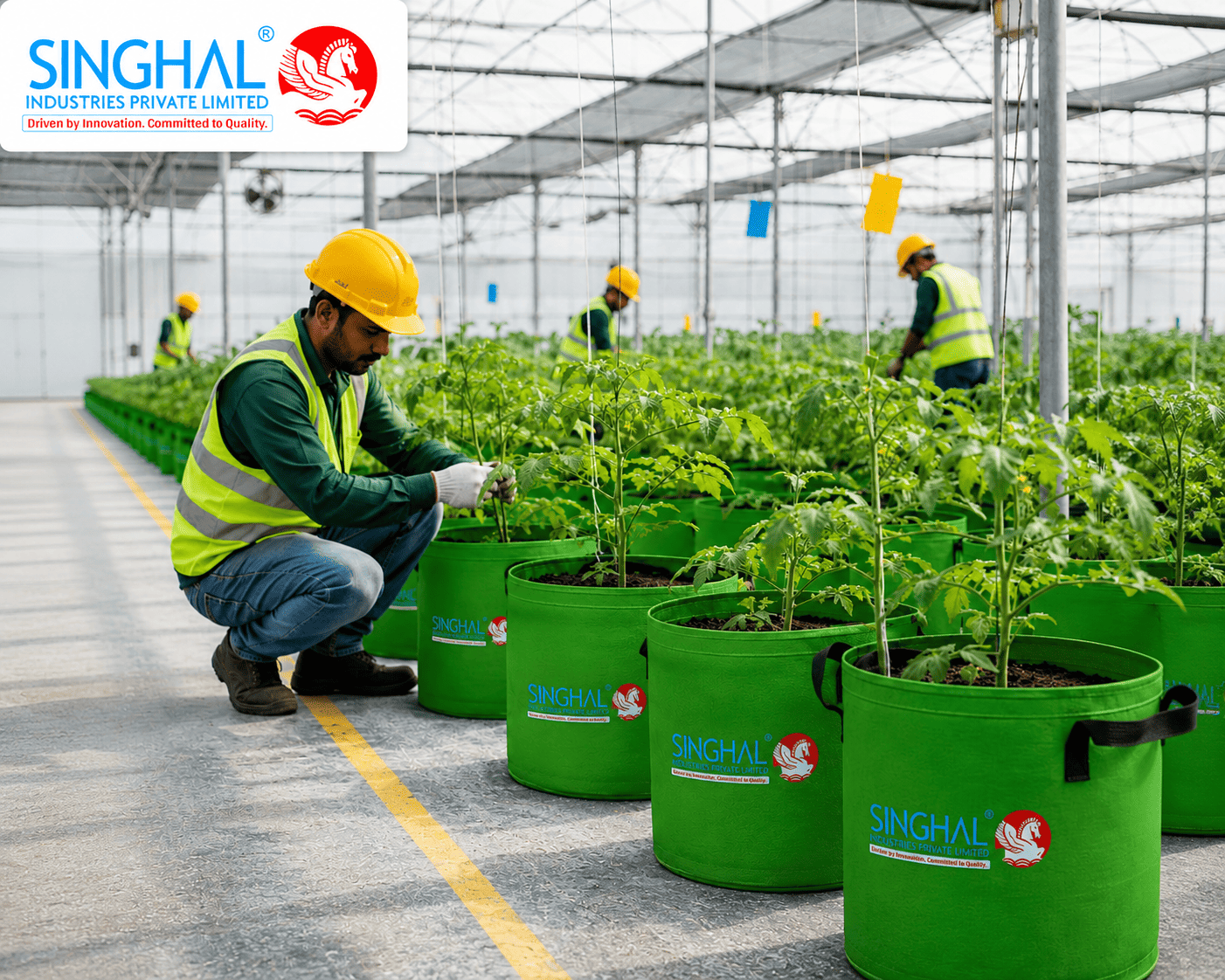
Your one-stop solution for grow bags manufacturers in India, grow bags supplier & exporter
Agricultural, Horticulture & Commercial Nursery Applications High Quality Planter Grow Bags.
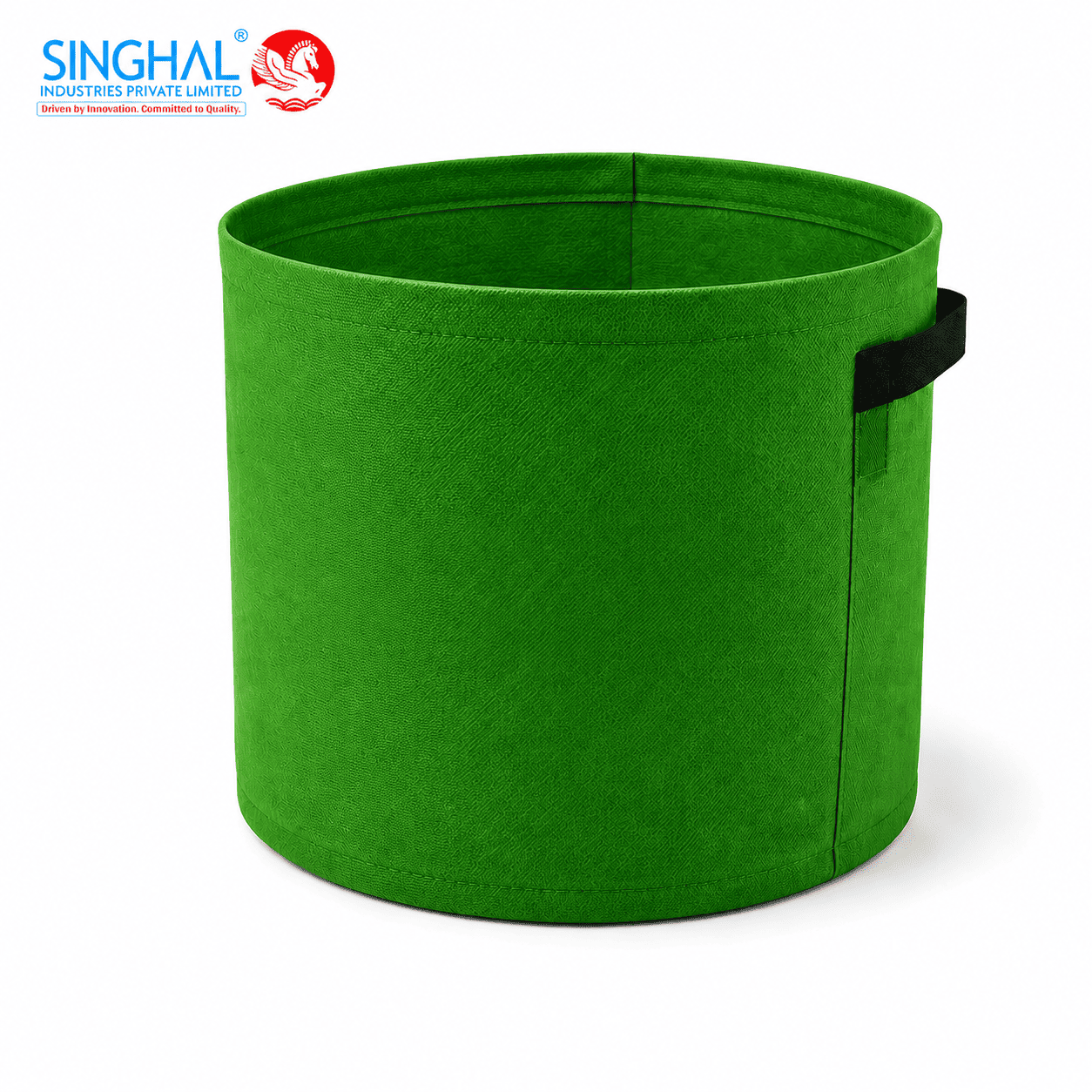
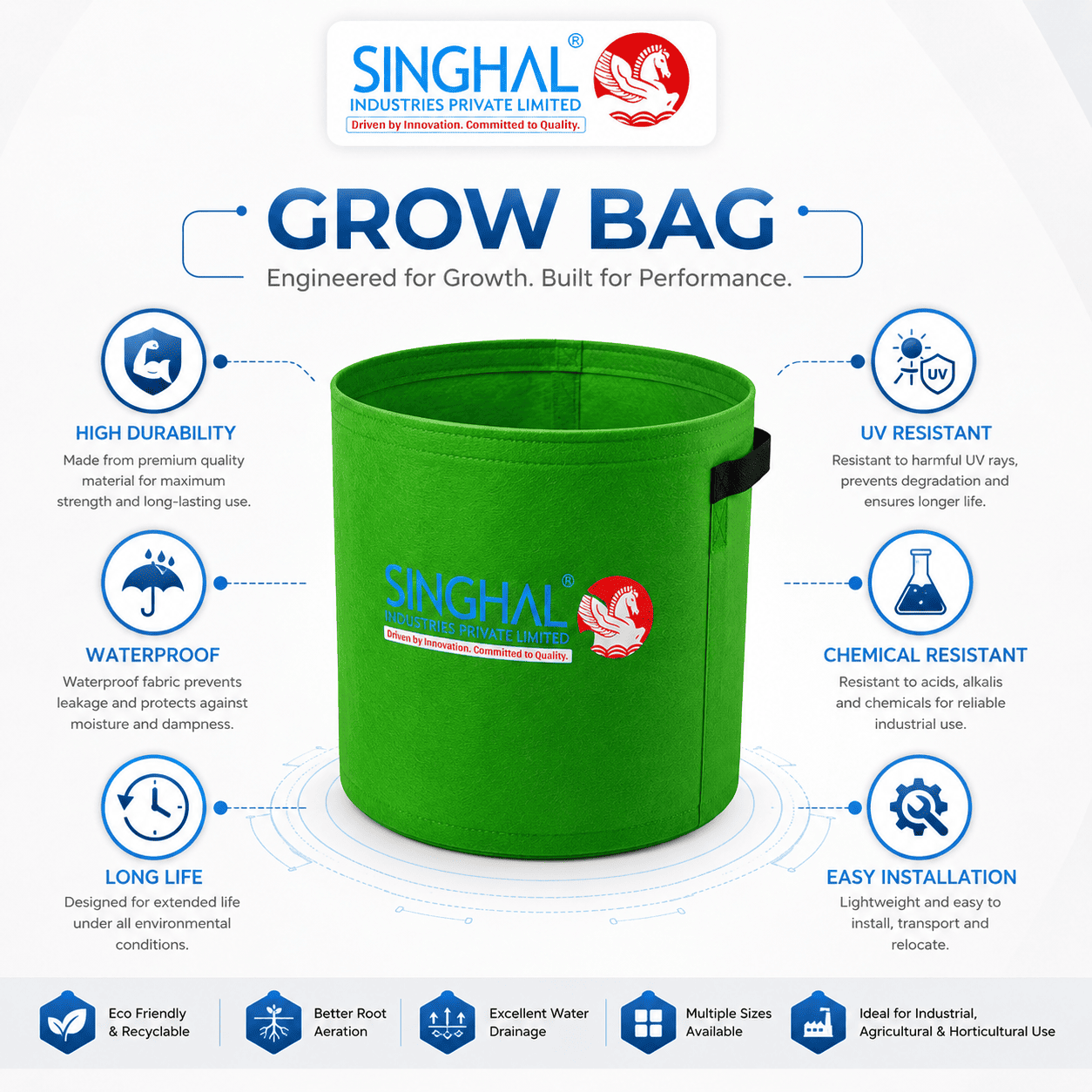
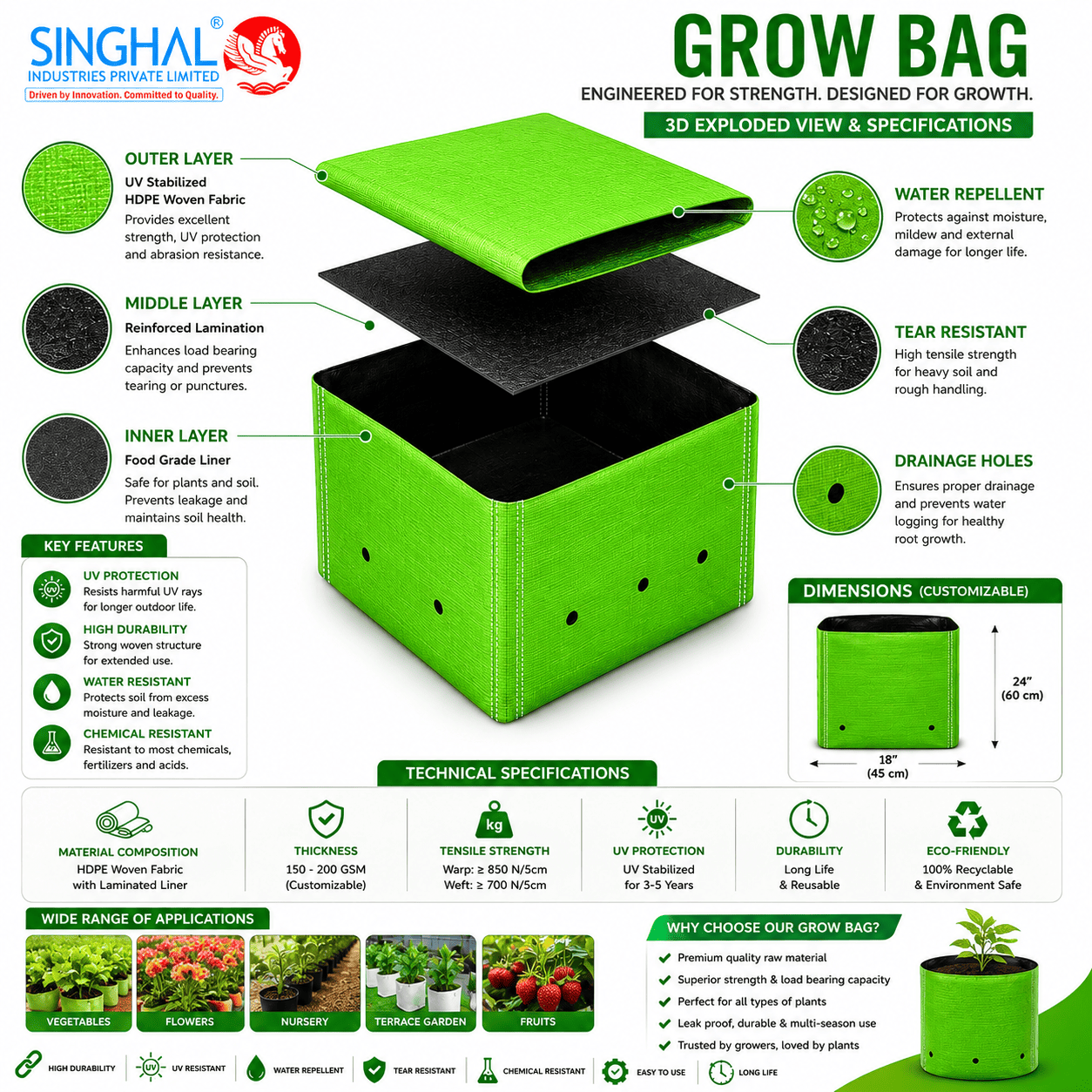
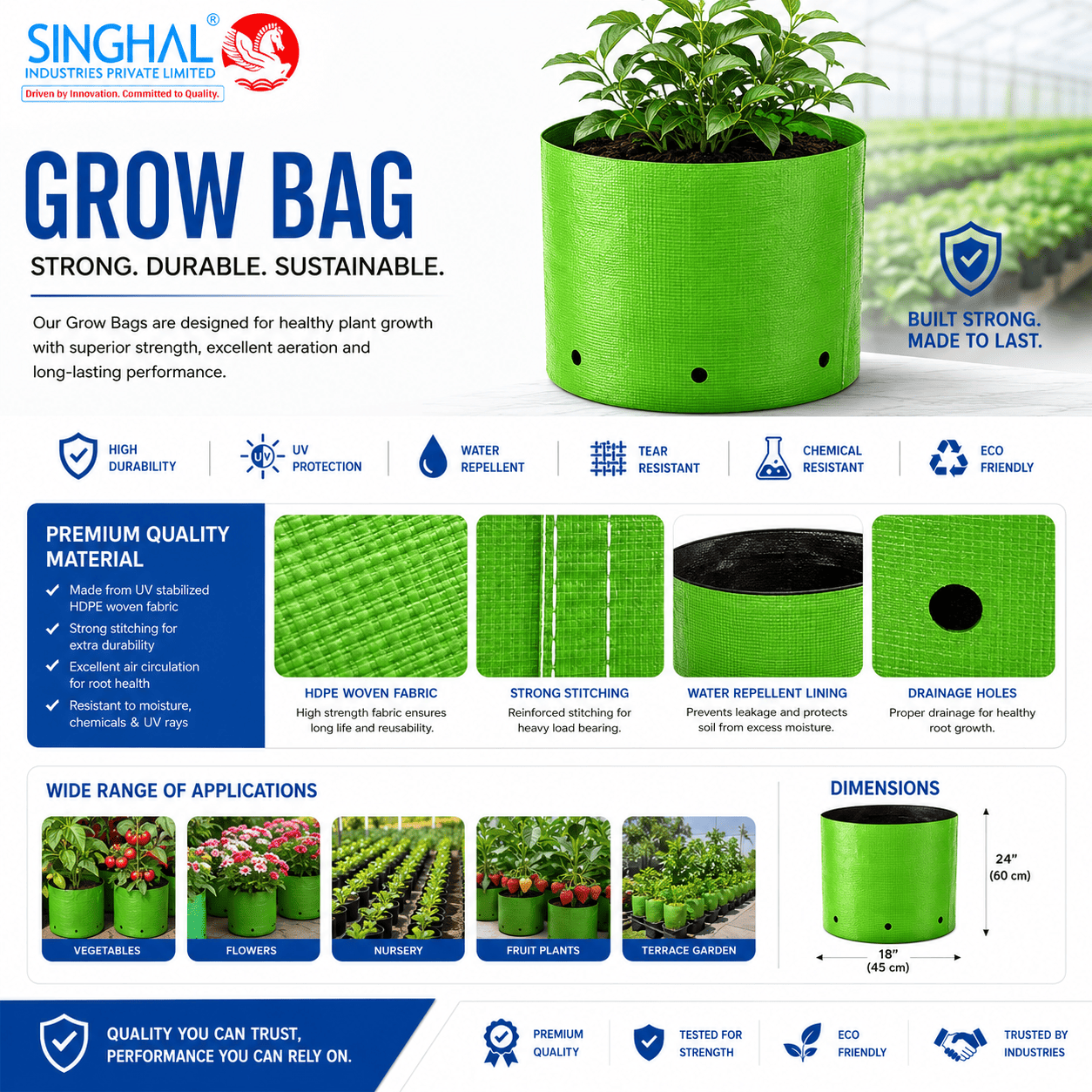
Singhal Industries Private Limited is a prominent Grow Bags manufacturer, supplier, exporter company of in India and provides high quality Planter Grow Bags for various applications in agriculture, commercial and engineering fields. We use high quality, UV-stabilized polymer resins and advanced fabricating systems to make our grow bags. Which offer exceptional chemical resistance, low weight, higher strength and durability.
The high performance planter bags are extensively used in commercial packaging, chemical industry, precision fabrication works, modern constructions, agriculture and all kinds of industrial farming installations. Our planter grow bags come in various thicknesses, sizes, color, surface finished. And bespoke specifications to satisfy a wide range of industrial and agricultural needs in terms of performance and reliability.
Grow Bags (Planter Grow Bags) are heavy duty thermoplastic or specially treated fabric containers for growing plants, which have superior chemical resistance, mechanical strength, low water absorptivity and flexibility. These planter sacks have many applications in the commercial agricultural and industrial fields, where a light-weight material which is structurally strong and economical over the total life-cycle is desired.
They are extremely effective in extreme conditions of constant contact with soil acid, alkalinity, and a wide variety of industrial chemical fertilizers, and are therefore ideal for chemical agricultural tanks, protective crop liners, custom fabrication systems, and bulk packaging applications. Polymer grow bags have the advantage of superior heat management, unmatched structural flexibility and outstanding space saving characteristics when compared to many traditional rigid clay or concrete pots and can be used in both enclosed greenhouse type structures and controlled outdoor cultivation in open fields.
Virgin Polymer Grow Bags
Made from pure polymer resins made from virgin materials to provide uncompromising quality of seams, a consistent molecular density and total quality for organic food cultivation.
Reprocessed Economical Grow Sacks
Planter bags that are cost-effective and made of premium recycled polymer material, perfect for landscapes with minimal requirements, projects, temporary seedling transportation and basic waste sorting.
UV Stabilized Grow Bags
Particularly designed with high-quality inhibited light stabilizers that protect against extreme solar radiation, and prevent the material from becoming hard or fracturing in harsh outdoor conditions.
Colored & Dual-Tone Grow Bags
Available in a variety of single colors, or in dual-tone design (such as white on the outside to reflect solar energy and black inside to stop growth of weeds) to assist in plant maintenance and asset sorting.
Textured / Heavy-Duty Fabric Grow Bags
With mechanically embossed or texturized surface finishes that give you more grip and friction. This prevents the bags full of contents from sliding off pallets during shipping.
Our manufacturing facility produces a variety of sizes, both custom and standard, to accommodate a variety of B2B wholesale distribution systems:
Singhal Industries Private Limited is producing premium quality planter grow bags in accordance with a well-defined automated quality protocol, with state of the art extrusion and fabrication machinery.
Singhal Industries Private Limited is one of the most reputed Grow Bags suppliers in the international market of polymers and known for providing high-grade engineered plastic packaging and customized intermediate containers. Some of our organization’s strengths are:
Grow bags are versatile growing containers that are highly used in commercial greenhouses, agricultural nurseries, landscaping business, and online pet supplies business to grow vegetables, fruits, berries, and trees.
Yes, our bags have better resistance to heat than thin commodity wraps, which ensures full strength and shape under the conditions of high temperature warehouses in summer.
Indeed, our grow bags have good chemical resistance, such as fertilizers, organic composts, nitrates, and soil acids without material deterioration.
Yes, we can sew easily. In addition, we can imprint names of the brands, crop information, and warning signs on the bags.
The raw polymer resin used is completely waterproof and has close to zero percent moisture retention. However, there are holes punched or porous weaved patterns in the bags to help with the drainage of excessive water in the bags.
A grow bag uses thicker, more UV-stabilized polymer resins meant for multiple plant growing cycles. On the other hand, a nursery bag is very thin and a one-time use black sack which is easy to tear and does not have any form of long term sun resistance.
Yes, our automated systems allow us to produce bags of all shapes, dimensions, tints, gauge thicknesses and drainage patterns suitable for automatic filling machines.
Yes, the polypropylene and high-density polyethylene are 100 percent recyclable thermoplastics and can be reprocessed into industrial products after their life span.
The grow bags are mostly used in commercial farming, retail nursery, landscaping designs, soil chemistry laboratories, packaging facilities, and civil engineering works.
This depends on the size of the root ball of the plant, total weight of soil, exposure to sunlight, and whether or not stacking vertically is preferred.
No, as our hydrophobic polymer does not have the capability of absorbing humidity or moisture from the environment and hence would not degrade even if stored at ports.
Our reprocessed material grow bags are inexpensive and best for landscaping projects, industrial waste recycling and planting of timber saplings. However, for organic grocery and berry products we recommend using our virgin material grow bags.
The bags have been designed using state-of-the-art UV light stabilizers during the extrusion process, thus preventing the bag from going brittle under prolonged exposure to the sun.
As a result of their enhanced density level between 0.90 and 0.96 g/cm³, these strong sacks contribute to an insignificant amount of deadweight to the cargo shipment, hence reducing the overall deadweight of the load.
Businesses may send their size specifications, required quantities and graphic prints to the central export trading desk to secure factory quotations and estimated time of manufacture.
| Chemical or Fertilizer Agent Type | Structural Safety Resistance Level |
| Concentrated Agricultural Acids | Excellent |
| Nitrate & Phosphate Alkalis | Excellent |
| Organic Compost Solvents | Good |
| Alcohols & Chemical Sprays | Good |
| Aggregates & Soil Minerals | Excellent |
| Water & Running Drainage | Excellent (Near-Zero Moisture Leaching) |
| Property | Premium Planter Grow Bag | Standard Thin Nursery Bag |
| Chemical Resistance | Excellent. Can handle the most aggressive fertilizers and soil acidity | Moderate thickness; the thin layer of films tear off or break down rapidly under exposure to chemicals. |
| Heat Resistance | Higher; insulates root zones against extreme ambient sun heat | moderate; traps intense heat radiation that causes scorching of the roots |
| Impact Strength | Walls that are heavy and high-quality protect against punctures by sharp stones. Stone aggregates | The thin, single-ply sheet easily splits open during the truck's journey |
| Flexibility Profile | Structural flexibility that is high; handles the rapid growth of roots | Medium; limited flexibility could cause micro-roots to be crushed during handling |
| Outdoor Lifespan | Good to Outstanding; strengthened with a deep UV protection | Poor; breaks and flakes in the sun's glare for one season |
| Cost Efficiency | High; multi-year reusable design offers long-term B2B savings | The profile is cheap and single-use. It will require frequent replacement |
High-end grow bags are used when long-term reuse of material as well as uncompromised root insulation and an extremely stable chemical structure are crucial while the standard nursery bags are used for temporary seedlings.
| Property | Premium Planter Grow Bag | Standard PP Woven Bag |
| Chemical Resistance | Fantastic; totally inert to chemical additives. | Excellent; extremely resistant to alkalis and acids. |
| Weight Profile | Lightweight material makes it easy for logistic lifting | Lightweight, lightweight material to transport large quantities |
| Flexibility | High stretching capacity helps maintain the same soil layout | High flexibility; can be used to fit bulk raw materials into packaging |
| Heat Resistance | Better; maintains form under hot greenhouse ceilings | Medium to high thermal boundary |
| Fabrication | Simple; includes integrated laser drainage punching | Simple and reliable; it allows standard industrial sewing and cutting and slitting |
Agriculture & Modern Horticulture
Widely utilized across precision hydroponic greenhouse systems polyhouses with drip irrigation, open-field organic ginger, berry and root crop plants.
Packaging & Transport Logistics
It is a safe inexpensive, low-cost intermediate bulk packaging material to transport live saplings and young plants, and top soil mixes that are safe from spills.
Chemical Industry & Soil Remediation
Lines for containers for testing soil in the industrial sector and the chemical wash basins for soil as well as secondary isolation systems where cross-contamination with chemicals must be eliminated.
Industrial Fabrication & Custom Growing Systems
Ideal for creating custom vertical farming dividers, custom-designed plant walls as well as partition liners. manufactured Urban landscaping items.
Construction & Environmental Engineering
It is used to construct strong sandbags for slope erosion control and green retaining walls. They also serve as temporary subgrade shields, as well as general barriers to waterproofing.
Automotive & Interior Greenery
It is used to create light interior decorative panels, cover for transport protection, landscaping elements, and for interior cabin utility partitions.
| Property | Specification |
| Material Base | High-Grade Polypropylene (PP) / High-Density Polyethylene (HDPE) |
| Density Index | ~0.90 to 0.96 g/cm3 |
| Thickness / Gauge Range | Fully Customizable to meet safe weight requirements |
| Width / Diameter Options | Fully customizable to match specific plant root spans |
| Length / Height Parameters | Fully customizable to fit small herb plants or deep tree roots |
| Surface Finish | Smooth / Matte / Textured or Perforated |
| Chemical Resistance | Very good (Immune to organic bio-composting as well as chemical feeds) |
| Water Absorption | Extremely High (Hydrophobic fiber base helps prevent blocking) |
| Heat Performance | Moderate to Moderate to (Maintains precision even in the hot zone) |
| Fabrication Properties | Easy High-Strength Sewing, Slitting & Machine Punching |
| Color Options | Natural, White, Black, Dual-Tone (White/Black) & Custom |
| Industrial Target Application | Recommended Thickness / Configuration |
| Retail Seedlings & Soft Herbs | Thin Flexible Sheets (100 to 150 Microns) |
| Greenhouse Hydroponic Runways | Medium Thickness Dual-Tone Sacks (150 to 200 Microns) |
| Commercial Tomato & Berry Cultivation | Medium Thickness Fabric Bags (200 to 250 GSM) |
| Orchard Saplings & Shrub Transport | Heavy-Duty Thickness Sacks (300 to 350 GSM) |
| Jumbo Landscape Trees & Deep Lining | Heavy Duty Rigid Blocks (400+ Microns / Extra Heavy GSM) |


