
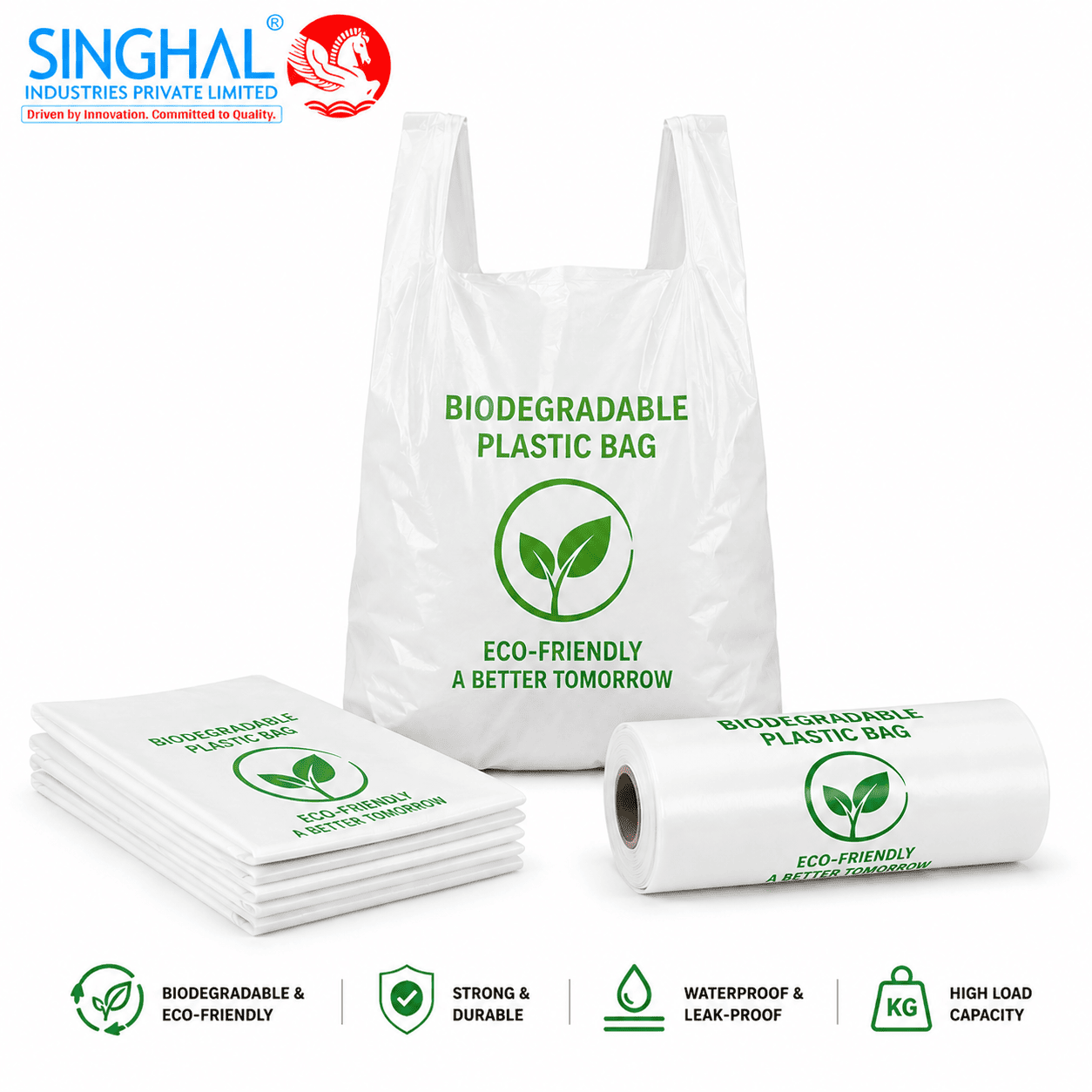
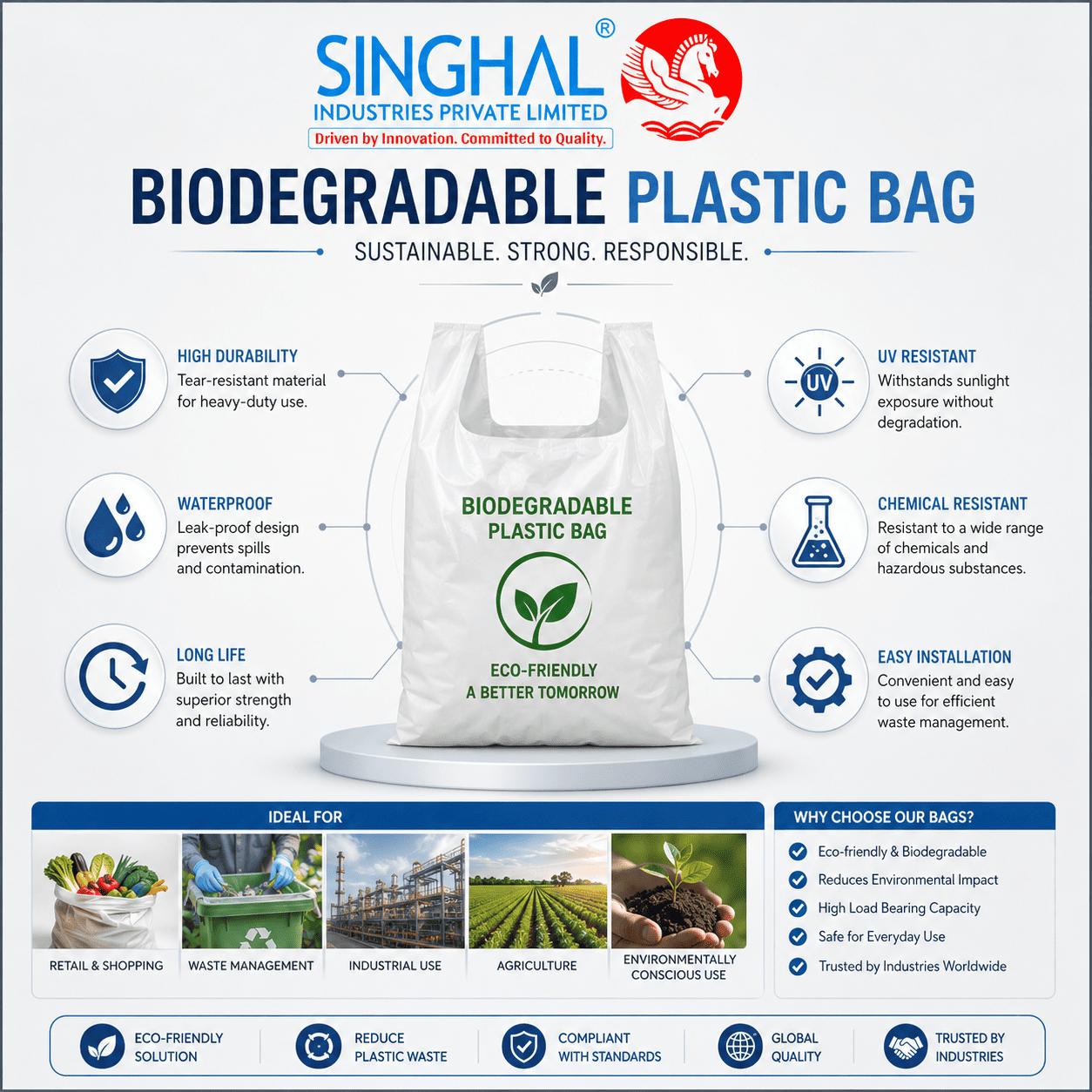
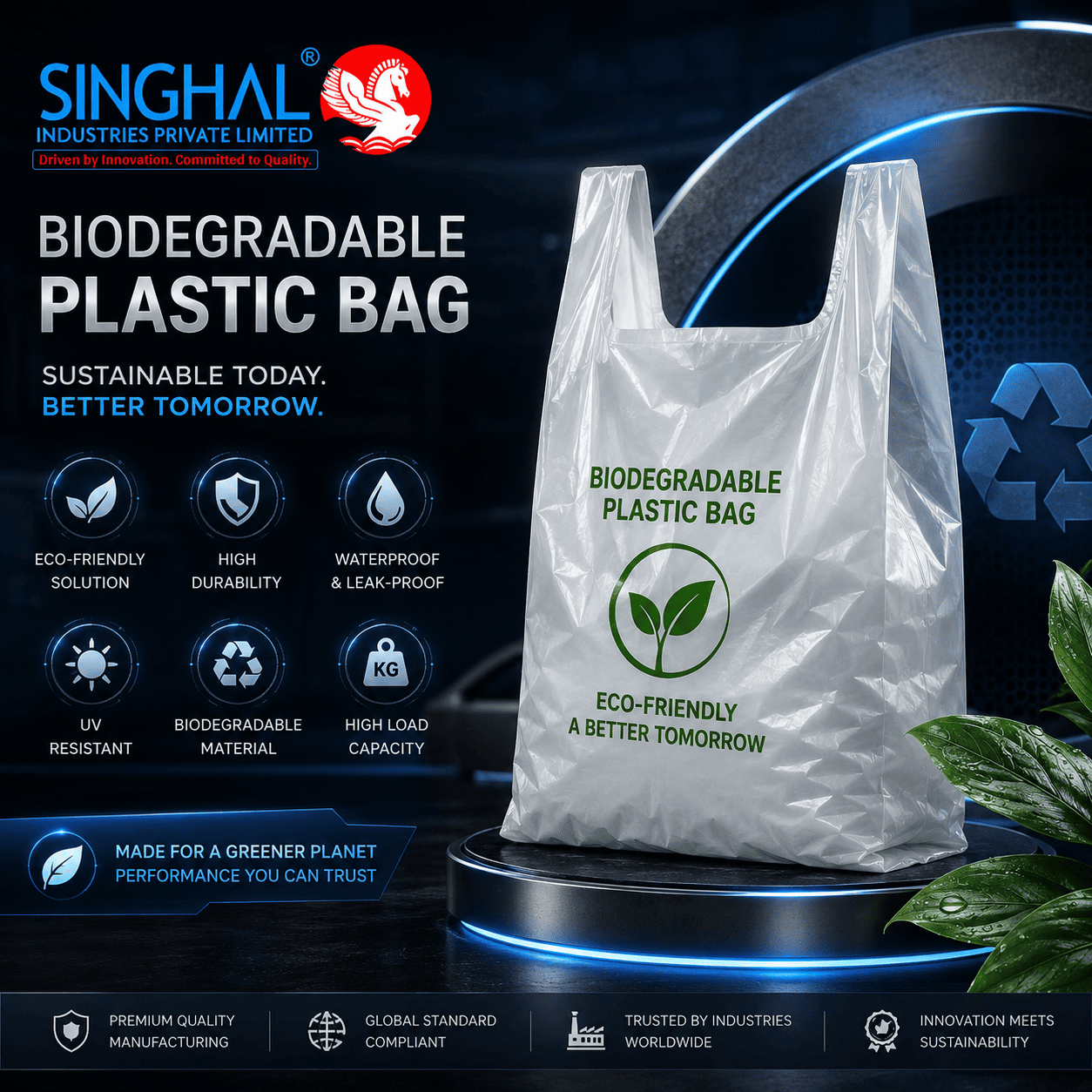
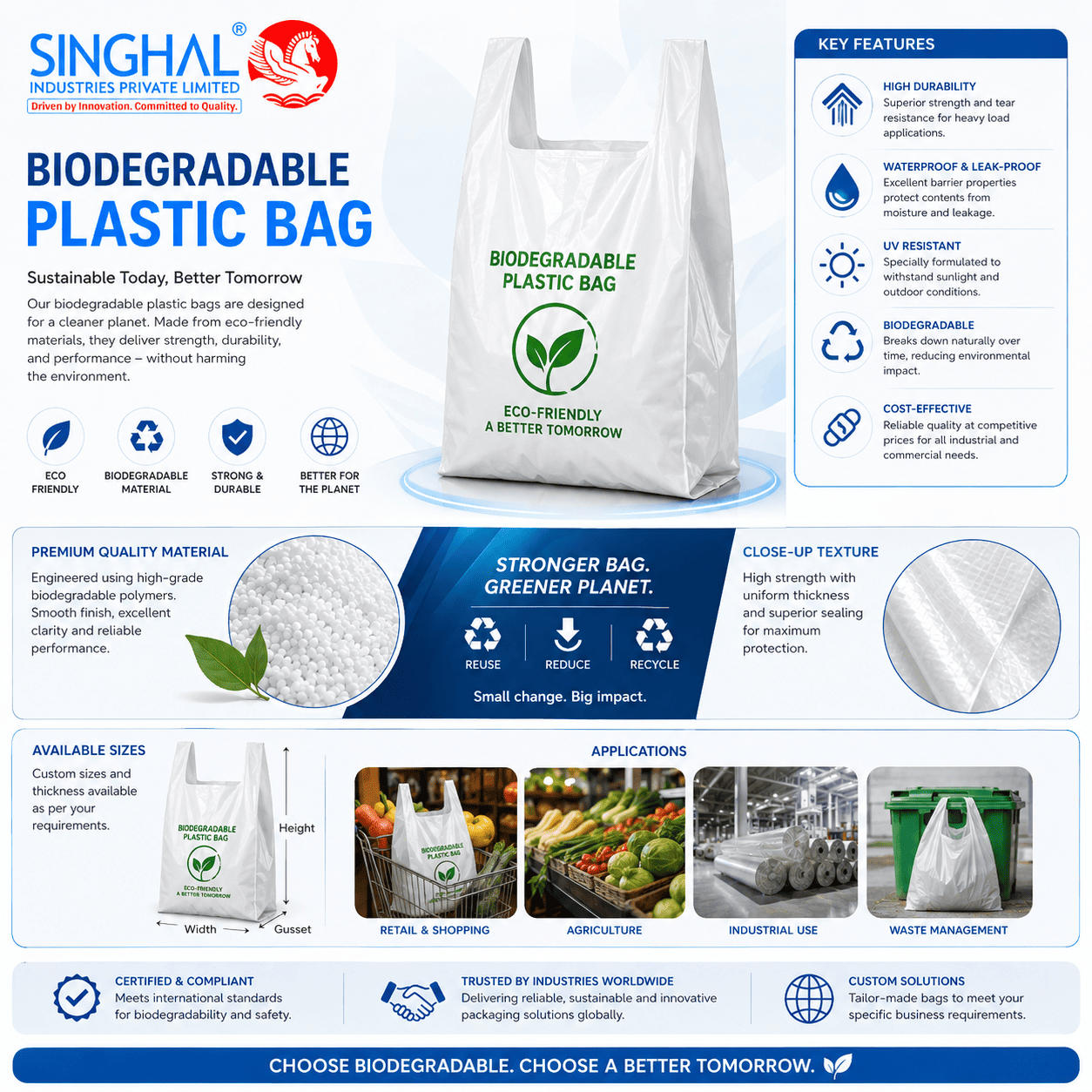
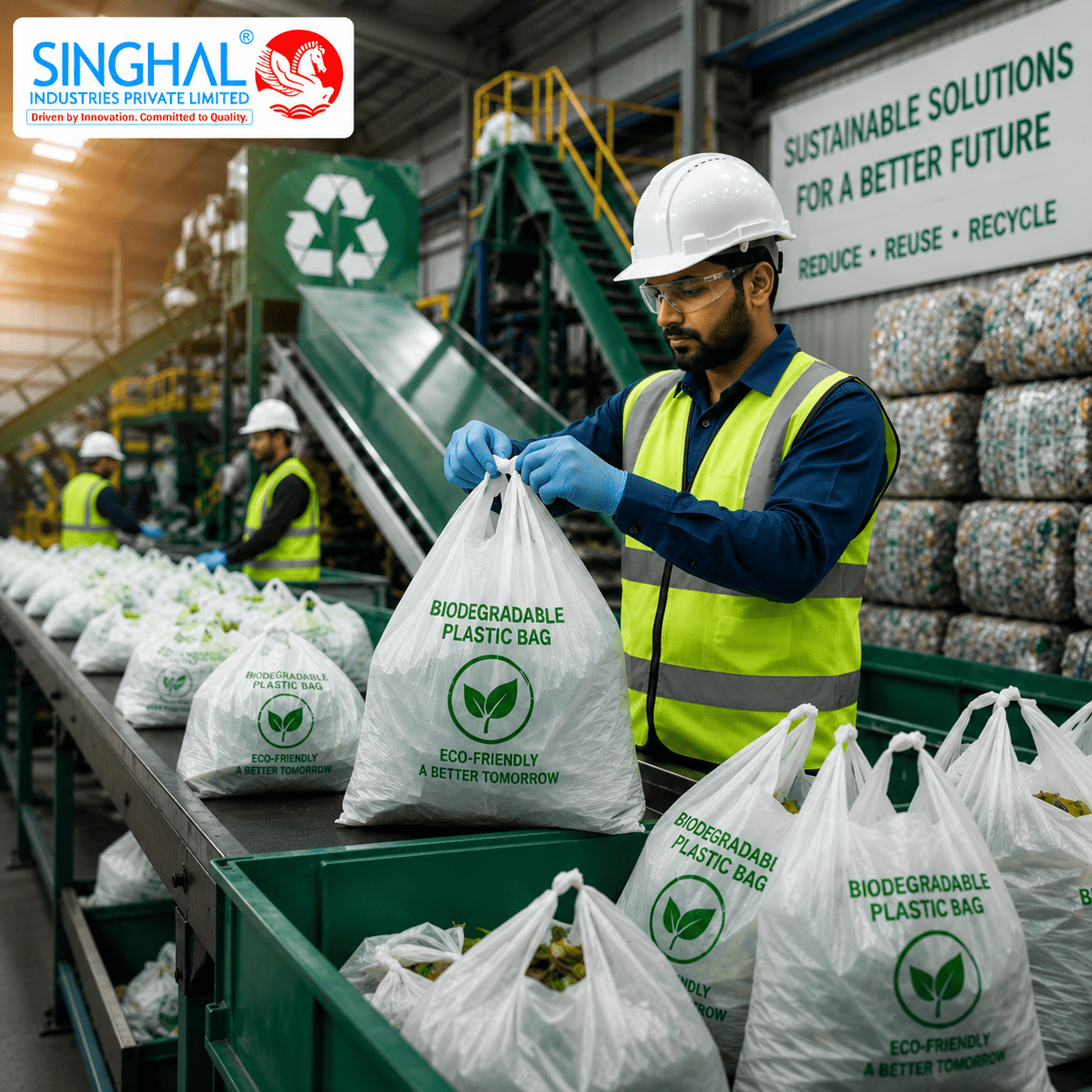
We deliver solutions as a supplier and exporter of biodegradable plastic bags
High Class biodegradable Plastic Bag For Industrial/Commercial/Retail Use Applications.
Singhal Industries Private Limited is an Indian manufacturer and supplier of Biodegradable Plastic Bags. We have several compostable packaging solutions for industry, retail and commercial use. The materials in our eco-friendly bags are manufactured with high quality resins, cutting-edge extrusion techniques, and environmental safety is a priority, along with lightweight and excellent drop-impact resistance, and long-term stable before disposal.
The bags come in different use cases such as commercial packaging, corporate waste disposal, agricultural cultivation and transportation, food service, and industrial packaging. We offer a variety of thicknesses, colors and finishes for our biodegradable carrier bags and trash bags.
They are known for their high structural flexibility, excellent mechanical strength, controlled water absorption and good organic breakdown abilities. The bags, which do not contain toxic residues or microplastics when broken down, decompose micro organically, unlike traditional fossil fuel-based plastics which can stay in landfill for decades.
In many industrial and commercial applications, Biodegradable Plastic bags are available and used to deliver lightweight packaging that is extremely resistant to puncture. These are also cost efficient. These bags perform extremely well in municipal environments. They are compatible with organic kitchen scraps and wet food waste. Biodegradable bags are superior to synthetic bags because they offer a better eco-balance, excellent chemical passivity and are ideal for corporate retail outlets, sustainable campuses and environmentally conscious shipping.
Virgin Bio-Based Bags
Composed of 100% pure cornstarch or PLA composite resins, providing a best possible material consistency and high tear resistance.
Retail T-Shirt Carrier Bags
These bags feature comfortable and sturdy vest or punch-out handles. They are also designed with gusseted side panels to securely hold retail consumer products at checkouts.
Roll-Form perforated liners
On request, these rolls are available as coreless continuous rolls with clean tear lines. They can be easily dispensed in commercial kitchens or corporate offices.
Color coded Organic Segregation Bags
These biodegradable containers come in different shades like light green and natural tan.
We can adapt our factories to your specific packaging configurations, waste disposal systems and dimensional requirements.
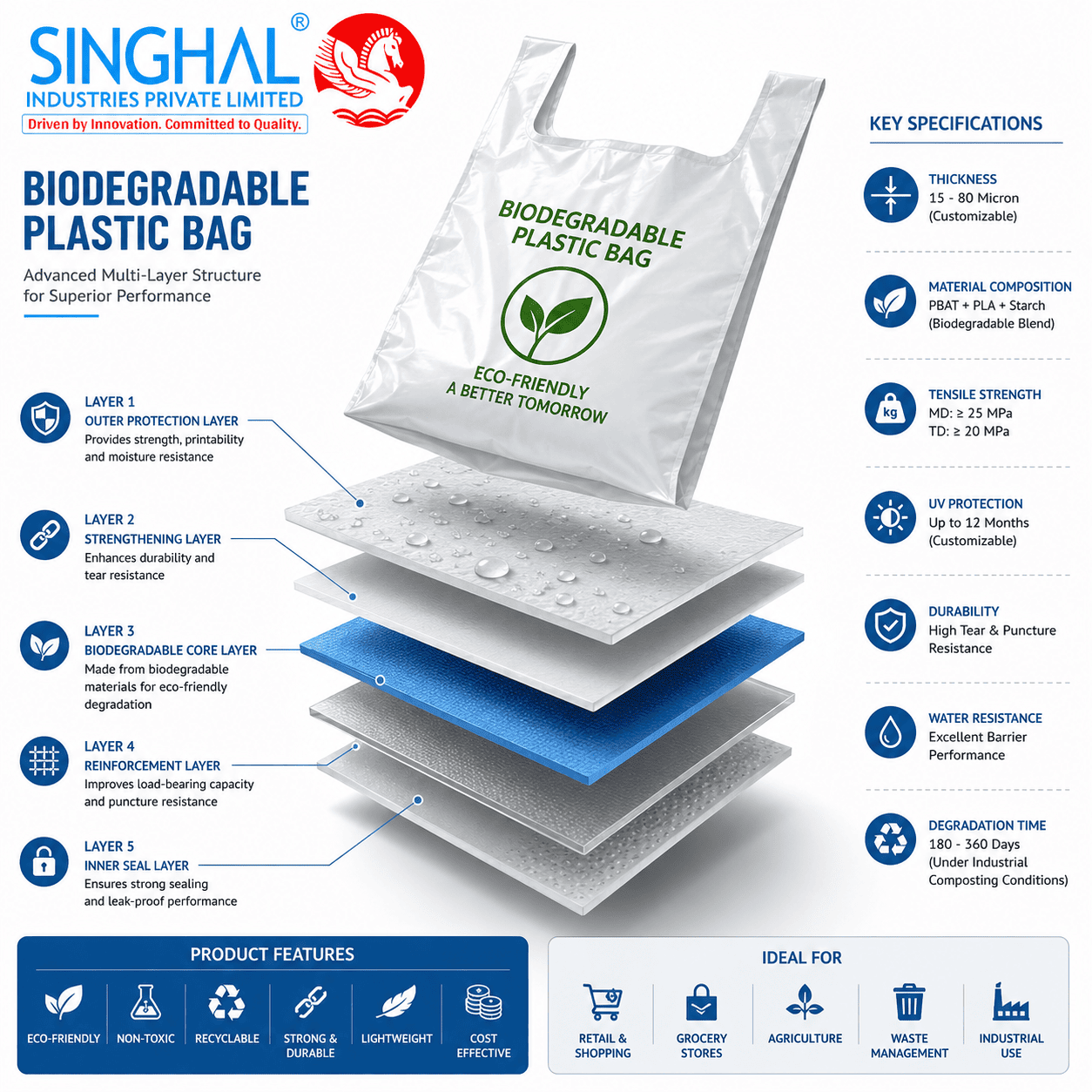
We at Singhal Industries Private Limited manufacture our biodegradable bags with strict quality parameters under Multi-layer co-extrusion blown film technology.
Singhal Industries Private Limited, a leading manufacturer of engineered plastic packaging as well as custom bio-based products is recognized globally for its high-quality solutions. Our structural corporate assets are:
Our focus is on providing consistent quality with uncompromising environmental safety in all industrial applications.
The use of biodegradable plastic bags is widespread in commercial retail checkout carriers, restaurant kitchen scrap collection, corporate trash bin liners and packaging for consumer products.
Our bags are heat resistant up to 55degC and remain structurally stable in standard industrial packaging or ambient warehouse conditions.
They are highly reliable in terms of waste collection because they have excellent resistance to kitchen grease, natural organic acids, weak household alkalis and moisture.
This will enable them to produce clean and airtight bottom welds on high-speed automatic packaging machines.
Yes.
PLA biodegradable bags are plant-based and sustainable. Such bags break down into compost. LDPE bags are based on petroleum. It means that these bags do not decompose.
Singhal Industries Private Limited provides such a possibility. You may select the custom roll sizes and thicknesses along with the high-contrast logos printed with eco-friendly inks.
No.
Biodegradable bags can be successfully applied in the fields of retail e-commerce packaging and facilities management. They are also used in agricultural cultivation, commercial accommodation, and consumer products manufacturing.
It depends on the weight of your product, risk factors during transportation and environment-friendly goals. Groceries would require bags of 15 microns. Heavy duty bags of 60-80 microns would be suitable for industry waste.
No. Our bio-fibers, though intended to be environment-friendly, can resist moisture. However, these bags will break only in case of disposal in a composting site.
For safe use, we advise you to use our virgin bio-based 100% pure bags for packing organic products.
It have been made stable in order to avoid breaking during transportation. Nevertheless, they need to be kept away from sunlight when being stored.
The bags mentioned above have been designed to achieve optimum density and hence add little weight to bulk cargo. This helps in minimizing your deadweight costs and cuts down your freight costs.
Procurement managers can contact the export trading division directly and give required size profile and thickness ranges.
| Chemical Factors | Structural safety resistance level |
| Organic Acids (Citric/Acetic) | The material is strong and does not rot. |
| Weak Household alkalis | Excellent |
| Vegetable oils and animal fats | It is good (prevents the bag from leaking greasy residue) |
| Alcohols & Disinfectants | Good |
| Industrial Hydrocarbons | Moderate to Low (Not Recommended for Petroleum Chemicals) |
| Pure Moisture & Water | Controlled resistance (Repels liquids from the outside while accelerating degradation) |
| Property | Biodegradable plastic bag | LDPE Garbage Bag |
| Chemical Foundation | Bio-based resins | Low-Density Plastic Ethylene Derived from Petroleum |
| Environmental Lifespan | In industrial composting, the material degrades in 180 days | Municipal dumps have been a source of contamination for hundreds of years |
| Heat Resistance | Moderate; best suited for environments under 55degC | Maintains form stability at 80degC |
| Material Flexibility | High stretch capacity with a soft matte feel | High-elasticity and higher drop-impact absorbency |
| Outdoor Performance | Modest; degrades over time when exposed to moisture | It is important to use UV-blocking chemicals. |
| B2B Procurement value | Value-added from green metrics and sustainable corporate scores reached maximum level | Recycling of non-organic industrial waste is economical |
LDPE bags are suitable for storage and disposal of sharp, heavy construction waste.
| Property | Biodegradable plastic bag | Biohazard Bag |
| Regulatory Color Code | Translucent, Milky White or Standard Green | Safety indicators in Red or Yellow High Contrast |
| Material Permeability | Permits breathing for organic degradation | Ensures pathogen isolation with impermeable, leak-proof property |
| Main target waste type | Agric produce, food scraps leftovers and light paper refuse | Medical waste, pathological swabs and infectious waste |
| Fabrication Standard | Construction that decomposes cleanly and is eco-friendly | Bio-fluids can be contained in thick plastics with extra-strong seams |
Retail & E-Commerce Packaging
Eco-friendly bags are widely used as eco-friendly, premium shopping bags by grocery chains, fashion boutiques and electronics retailers. They can also be used to wrap mailers for sustainable supply chains.
Hospitality & Food Service Sector
Use in hotels, restaurants, and commercial cafeterias to collect organic waste. The bag can be disposed of with the scraps.
Agriculture & Horticulture
Use as a protective crop liner, sapling nursery roots bags, collection sacks of organic fertilizers and greenhouse ground waste containers.
Corporate Offices and Institutional Campuses
Facilities management teams can use these to line waste bins at desks and compostable food scraps in the lunchroom, while supporting corporate green initiatives.
Industrial Manufacturing Component Logistics
Ideal for organizing parts in production workshops. Also acts as dustproof covers on subassemblies and for lining shipping boxes.
| Property | Specification |
| Material Base | Blend Matrix of Polylactic Acid (PLA) / Cornstarch / PBAT |
| Density Index | 1.20 - 1.30 g/cm3 |
| Thickness Range | 15 Microns up to 80 Microns |
| Width Scale | Customizable for bulk loads. |
| Length Scale | Customizable Bulk Capacity: 10" to 60" |
| Surface Finish | Smooth Matte/High-Clarity Film/Embossed Anti Slip |
| Chemical Resistance | Good (Resistant against mild household chemicals and organic vegetable acids) |
| Water Absorption | Controlled low absorption (maintains structure when dealing with wet waste) |
| Thermal Resistance | Moderate (Maintains form stability up to 55degC). |
| Fabrication Properties | Excellent Thermal Die Cutting & Structural Stitching. |
| Color Parameters | Available in Customized Pigments, Milky White Translucent, Natural green and Custom Colors. |
| Industrial Target Application | Recommended Film Gauge Thickness |
| Bags for Produce & Pharmacy Pouches | Thick Gauges (15 microns to 20 microns) |
| Standard Check-Out Carrier Bags & Retail Boxes | Medium Thickness (25 microns to forty microns) |
| Cafeteria Garbage Liners & Fabrication Packaging | Medium-Thick Gauges 45 Microns to 60% |
| Heavy Compost Sacks & Industrial Liners | Heavy Duty Gauges (65 microns to 80 microns) |


